
[Movie Review] Kiss of the Spider Woman (2025)
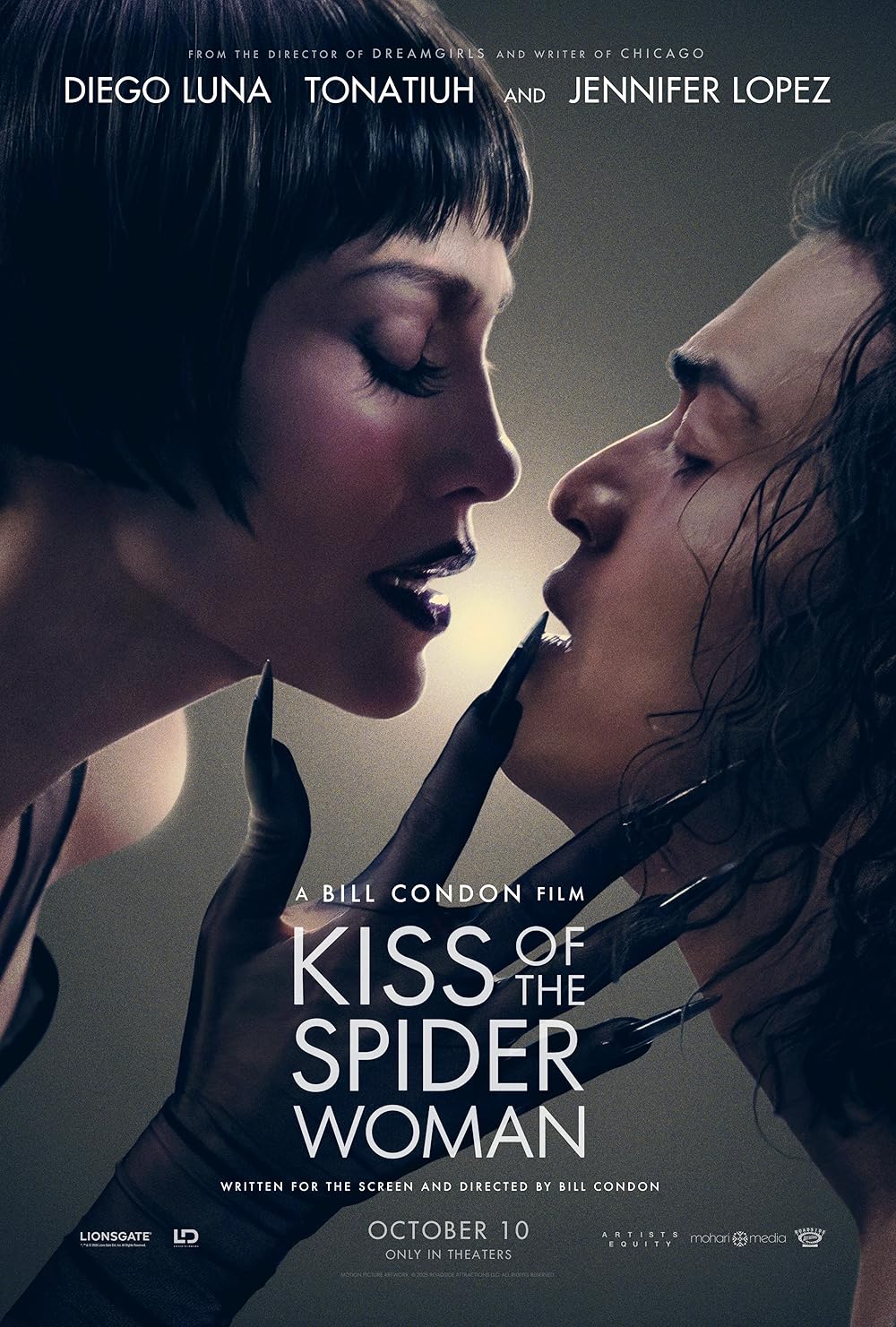
Plot Summary: In 1970s Argentina, Molina, a window dresser convicted of public indecency is assigned to share a cell with Valentín, a political prisoner arrested for his activism. The strange pair bond against all odds as Molina conveys the plot of “Kiss of the Spider Woman,” a shiny Hollywood musical featuring the silver screen idol, Ingrid Luna.
Runtime: 128 minutes
Director: Bill Condon
Screenplay writer: Bill Condon
Based on: Kiss of the Spider Woman (musical) by Terrence McNally, John Kander and Fred Ebb and Kiss of the Spider Woman (novel) by Manuel Puig
Main Cast:
- Jennifer Lopez as Ingrid Luna/Aurora/The Spider Woman
- Diego Luna as Valentin Arregui/Armando
- Tonatiuh as Luis Molina/Kendall Nesbitt
Review by: Lauren
When Kiss of the Spider Woman opens in a claustrophobic prison cell, you can feel the weight of the stage still clinging to the screenplay. The early dialogue–dense, a little too rehearsed–struggles to breathe. But stay with it. What starts as a stiff adaptation blooms into something far more moving, more genre-bending, and ultimately more radical than I expected.
Let’s start with Tonatiuh, who plays Molina. At first, I wasn’t convinced. His performance felt over-calculated, like he was still finding the rhythm between theatrical flourish and cinematic nuance. But then came “She’s a Woman,” a gorgeously mournful ballad that marks the emotional center of the film–and Molina’s character. In that number, Tonatiuh peels back the artifice and gives us something real: hope, longing, and a wistful kind of joy. From there, I was won over. His Molina is fierce, funny, and deeply yearning.

Where the performance falters, however, is in Tonatiuh’s dual casting as the “gay assistant” within the 1950s film-within-the-film, a meta narrative device lifted from the original novel and musical. His portrayal there feels overly serious, bordering on inert. It’s a missed opportunity, especially considering the compelling gendered lens the film otherwise applies. There’s so much unspoken marginalization packed into this archetype, the effeminate, ever-devoted aide to a glamorous star. I wish the film had dug deeper, especially beyond the emotional high point of “She’s a Woman.”

Visually, the contrast is staggering. The real-world prison scenes are grimy, cramped, and soaked in muted tones, while the fantasy sequences from the fictional “Kiss of the Spider Woman” studio picture burst off the screen: lavish, glittering, and saturated with era-appropriate spectacle. But even amid the glitter, the 1950s melodrama sequences occasionally feel hollow. They dazzle, yes, but they rarely charm. I kept wishing the film would more effectively marry the vintage genre beats–the close-ups, the lighting, the romance–with the deeper themes of resilience and impossible love.

That said, Jennifer Lopez, as the titular Spider Woman/Aurora/Ingrid Luna, delivers some of the best dancing of her career. In one particularly riveting number, “Gimme Love,” the film fully commits to camp: sequins, smoke, exaggerated gestures, the works. It’s a tonal shift that works, embracing a kind of theatrical femininity that’s both dangerous and divine. The Spider Woman’s presence as a metaphor–death, desire, fear, liberation–threads through the film like a haunting chorus, always nearby, always shimmering.

Gender identity is central here, and the film handles it with care. Molina is portrayed as a transgender woman in a time before that language existed for her. She is given room to be soft, funny, glamorous, and complicated. She decorates her corner of the prison with movie posters, silky fabrics, and dreams deferred. Through her relationship with her cellmate, Valentín, she finds something like love, or at least, recognition. There’s a tenderness in their banter that transcends labels.

The film does lose some momentum post-prison. After Molina agrees to help the revolutionaries and attempts a doomed escape, the pacing stumbles. Her death–shot down by the very people she tried to help–feels both inevitable and cruel. The final sequence, though a little too explanatory in its voiceover, offers a bittersweet kind of fulfillment: Molina, at last, dressed as she wants to be, walking with grace and purpose into a light she’s long deserved.
“Kiss of the Spider Woman” may not fully escape its theatrical roots, but it takes bold steps into the cinematic, blending fantasy and reality with heart. Despite its imperfections, it’s a film that dares to imagine beauty where there is none.
Summary
Kiss of the Spider Woman is moving and visually stunning, but a bit uneven. Tonatiuh, Diego Luna, and Jennifer Lopez provide a trifecta of talent throughout.
Images Courtesy of IMDB
Share this with friends:

Discover more from The Grand Shuckett
Subscribe to get the latest posts sent to your email.