
[Movie Review] Mercy (2026)

Plot Summary: Set in the near future, a detective accused of murdering his wife has 90 minutes to prove his innocence to an advanced AI judge.
Director: Timur Bekmambetov
Writer: Marco van Belle
Runtime: 1 hour 39 mins
Main Cast:- Chris Pratt as Chris Raven
- Rebecca Ferguson as Judge Maddoz
- Jali Reis as Jacqueline "JAQ" Diallo
- Annabelle Wallis as Nicole Raven
- Chris Sullivan as Rob Nelson
Review by: Samuel
Mercy is a futuristic sci-fi thriller starring Chris Pratt and Rebecca Ferguson that immediately calls to mind Minority Report, though I’ll say upfront it’s not quite on that film’s level, but clearly cut from the same cloth.
Set in a near future, the film introduces the “Mercy System,” a radical new approach to criminal justice designed to eliminate crime and speed up convictions.

Under this system, accused criminals are placed before an AI judge who has access to every digital feed in the city. Any electronic device connected to the cloud can be used as evidence, which the Judge presents in real time through immersive, augmented-reality reconstructions. Once accused, a defendant has 90 minutes to prove their innocence. If they fail, they are executed on the spot.
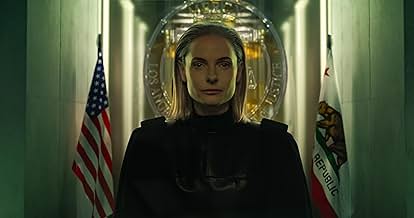
Chris Pratt plays the latest person subjected to the Mercy System after being accused of murdering his wife. He begins the process rated at roughly 97% guilty and must lower that number below the 92% threshold to survive. Rebecca Ferguson voices and embodies the AI judge overseeing his case, guiding him through evidence while remaining (at least in theory) completely impartial. The film unfolds almost entirely in real time as Pratt races against the clock to prove he did not commit the crime.

What I Didn’t Like:
Let’s begin with my dislikes (and end positive). My biggest issue with Mercy has nothing to do with its pacing, cinematography, or overall craft—it’s the believability of the system at the center of the story. The Mercy System is deeply flawed, and those flaws were constantly on my mind while watching the movie.
The convictions we’re shown often feel circumstantial, even with access to near-total surveillance. Everything Chris Pratt’s detective character –named detective Raven-uncovers is something the AI had access to and theoretically should have also uncovered.

Also, just the overarching idea that someone could be tried, convicted, and executed within 90 minutes feels wildly irresponsible, and the movie doesn’t quite convince me that society would ever adopt a system this extreme. That disbelief became distracting as I tried to accept the reality of the world being shown.
Another issue with believability is that defendants are required to defend themselves without a lawyer. If you don’t have the mental capacity, emotional stability, or investigative skills to comb through massive amounts of evidence, you’re essentially doomed. Chris Pratt’s character is a detective with law enforcement friends who can help investigate, chase leads, and examine crime scenes. But what about everyone else? The other people processed through this system (18 before detective Raven) didn’t have “boots on the ground” helping them. That imbalance makes the system feel fundamentally unfair.
The last thing I will mention is somewhat predictable. There are two major twists. One I saw coming a mile away, and while the other initially surprised me, once the story started heading in that direction, I was able to guess how things would end well before the runtime was over. And, that ending itself also feels abrupt, cutting off without the level of resolution I expected.

What I Liked:
Despite those issues, Mercy is an entertaining watch. The real-time structure works well, especially since the film’s runtime closely mirrors the 90-minute deadline within the story. I appreciated that it didn’t overstay its welcome and kept things moving.
Chris Pratt and Rebecca Ferguson are the film’s biggest strengths. Their dynamic carries the movie. Ferguson, in particular, is excellent as the AI judge. She’s meant to be unemotional and impartial, yet subtle moments suggest learning, curiosity, and even empathy beneath the surface. She manages to feel robotic and human at the same time, which is no small feat.
Pratt is solid as well, even if the movie occasionally suggests more emotional depth than it fully explores. His character’s trauma and reliance on alcohol are interesting ideas, though I don’t think the film digs into them deeply enough. Still, watching him work through the evidence and apply his detective instincts was engaging.

I also really enjoyed the visual interface of the Mercy System. The augmented reality reconstructions are a standout element. When evidence is presented, detective Raven is placed directly into the scene (for example, standing in the kitchen where the crime occurred). He feels explosions as they are replayed, and physically reacts as if he were there. It’s immersive, visually creative, and adds a lot to the tension. I can easily imagine this movie being even more impressive in 3D, which is not something I normally endorse.
While there isn’t a ton of action, I didn’t mind that at all. I was invested in the mystery and the back-and-forth between the man on trial and the AI judging his fate. Watching the system’s power unfold and watching the judge herself evolve was consistently engaging.
Summary
Mercy may not hold up to deeper scrutiny, but it succeeds as an entertaining sci-fi thriller with strong performances and a compelling central idea. If you’re intrigued by futuristic justice systems and don’t mind overlooking some logical gaps, you’ll likely have a good time.
Catch it at a matinee
Images Courtesy of IMDB
Share this with friends:

Discover more from The Grand Shuckett
Subscribe to get the latest posts sent to your email.